

Emergency Plumber
Emergency Plumber is the exact phrase you desperately type into your phone when the unthinkable happens in the dead of night, and it represents the ultimate lifeline for your home’s survival.
Let’s be completely honest for a moment: we take our home’s intricate infrastructure entirely for granted until the exact second it violently fails. You go to sleep expecting a quiet, peaceful night, only to be jolted awake at three in the morning by the unmistakable, horrifying sound of rushing water echoing down your hallway. Your feet hit a cold, completely saturated carpet, and instant panic sets in.

The ceiling is sagging, the drywall is actively dissolving, and you realize you have absolutely no idea where the main shut-off valve is located. In these high-stakes, adrenaline-fueled moments, the abstract concept of home maintenance instantly vanishes, replaced by the desperate, immediate need for an expert. This is the brutal, unforgiving arena of crisis management, where minutes literally equal thousands of dollars in property damage, and where knowing who to call can save your home from total ruin.
When disaster strikes, the last thing you want to do is frantically scroll through search results, blindly guessing which contractor might actually answer the phone. You need a steadfast, highly trained professional standing by. Relying on established, authoritative experts, like the dedicated rapid-response teams at The Plumbing Solution, transforms an uncontrollable nightmare into a managed, structured recovery process. In this extensive, deeply analytical guide, we are going to break down exactly what happens during a severe water crisis, how you can physically protect your home before the experts arrive, and why understanding the complex mechanics of an emergency plumber is the ultimate insurance policy for your property and your peace of mind.
What Actually Constitutes a Call to an Emergency Plumber?
The line between a frustrating inconvenience and a full-blown catastrophe can sometimes seem blurry to the untrained eye. If your kitchen sink is dripping slightly, it’s annoying, but it is a manageable nuisance that can wait until standard business hours. However, understanding the exact threshold that triggers the need for an emergency plumber is absolutely crucial. Misdiagnosing a severe problem as a minor issue is exactly how small leaks evolve into devastating structural failures.
A true crisis is defined by its potential to cause immediate, irreversible damage to your property, or by its ability to pose a direct, severe threat to the health and safety of your family. If water is actively flowing into your living spaces and you cannot isolate the source, you are in an emergency.
If your only toilet in the house has violently backed up and is spilling raw sewage onto the bathroom tiles, creating a severe biological hazard, you need an emergency plumber right now. If you smell the distinct, rotten-egg odor of natural gas near your water heater, you are in a life-threatening situation. These are not scenarios where you wait for Monday morning; these are moments that demand immediate, aggressive intervention from a seasoned professional.
The Burst Pipe Catastrophe and Your Emergency Plumber
To truly understand the stakes, we need to look at the physics of a burst pipe. Water inside your home’s supply lines sits under immense, constant pressure—often between 40 and 60 pounds per square inch (PSI). When a copper pipe freezes and splits, or when a corroded joint finally gives way, that pressurized water doesn’t just leak; it aggressively sprays with violent force.
Within a matter of ten minutes, a single half-inch ruptured pipe can pump hundreds of gallons of water directly into your wall cavities. The water fiercely seeks the lowest point, destroying electrical wiring, soaking fiberglass insulation until it becomes heavy and useless, and eventually pooling on your ground floor. A professional emergency plumber understands this relentless physics. They do not just arrive to patch a hole; they arrive to strategically isolate the pressure zones, stabilize the environment, and halt the aggressive spread of water before it compromises the structural load-bearing elements of your house.
The Hidden Costs of Delaying an Emergency Plumber
It is a very common, highly destructive human instinct to downplay a crisis in the hopes that it will somehow resolve itself. “Maybe the dripping will stop,” we tell ourselves. “Let’s just put a larger bucket under it for tonight.” This psychological denial is the most expensive mistake you can make when dealing with residential water infrastructure. Delaying the arrival of an emergency plumber triggers a devastating domino effect of secondary damage that insurance companies often fiercely contest.
Think about the biological aftermath of a flood. When water saturates organic materials like wood framing, drywall paper, and carpet padding, it creates the absolute perfect breeding ground for toxic black mold. Mold spores can begin germinating in as little as 24 to 48 hours in a damp, warm environment. If you hesitate to call an emergency plumber, you are not just dealing with water extraction; you are actively signing up for a massive, heavily regulated hazardous materials remediation project. What could have been a standard late-night pipe repair rapidly inflates into a structural teardown and mold abatement nightmare.
How The Plumbing Solution Deploys an Emergency Plumber
When you are standing ankle-deep in freezing water, you don’t need a salesman; you need a tactical expert. This is precisely where the philosophy of The Plumbing Solution separates them from the rest of the industry. They treat dispatching an emergency plumber not as a simple repair job, but as a critical triage operation. Their dispatchers are trained to guide you through immediate safety protocols over the phone—like shutting off the main breaker if water is near outlets—while a fully stocked, fully stock van is immediately routed to your address.
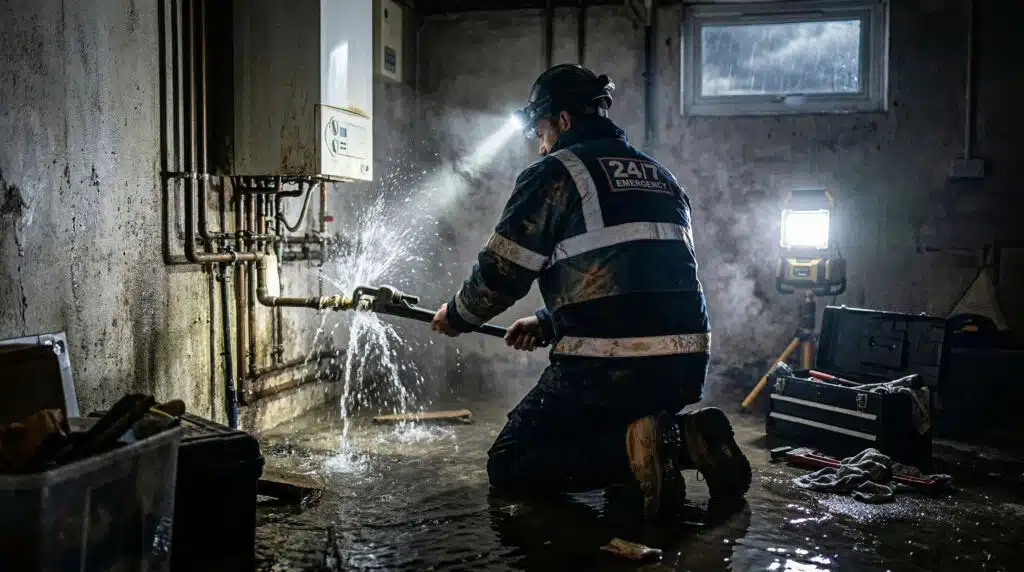
Their technicians arrive with commercial-grade water extraction plans, advanced diagnostic thermal cameras to trace the hidden path of the leak, and the authoritative competence required to instantly calm a panicked homeowner. They represent the gold standard of crisis mitigation.
Crucial First Steps Before the Emergency Plumber Arrives
While a professional emergency plumber is speeding toward your home, the actions you take in those agonizing first fifteen minutes can drastically alter the outcome of the disaster. You cannot simply stand there and watch the water rise. You must take immediate, calculated action to protect your family and your property while you wait for help.
First and foremost, you must locate and engage the main water shut-off valve. This is the single most important mechanical component in your entire house. Every adult in the household should know exactly where this valve is—whether it’s in the basement, a utility closet, or out by the street meter—and how to turn it off. By killing the main supply, you instantly depressurize the entire system, turning a catastrophic geyser into a manageable residual drip.
Secondly, you must address electrical safety. Water and electricity are a highly lethal combination. If a pipe has burst in the ceiling and water is raining down through your light fixtures or running down the walls into your power outlets, do not walk into that room. Go immediately to your main electrical panel and completely shut off the power to the affected zones, or the entire house if necessary. Only after the electrical threat is neutralized and the water flow is stopped should you begin trying to save your physical possessions.
Mitigating Water Damage for Your Emergency Plumber
Once the immediate threats are contained and you are waiting for your emergency plumber, you can begin damage control. Move expensive electronics, irreplaceable family heirlooms, and wooden furniture away from the pooling water. If the water is clean (from a supply line, not a sewer backup), use heavy towels, mops, or a wet/dry shop vacuum to remove as much standing water as physically possible.
Open windows to encourage airflow, provided it isn’t freezing outside. Every single gallon of water you physically remove from the floors before it has a chance to soak deeply into the subflooring saves your emergency plumber valuable time and reduces the risk of long-term warping and rot to your home’s foundational layers.
Preventative Measures: Avoiding an Emergency Plumber
While knowing how to react to a crisis is vital, the ultimate goal of any responsible property owner should be entirely avoiding the need for an emergency plumber in the first place. The secret to a dry, stress-free home is proactive, relentless maintenance.
Think of your plumbing service like the engine of a high-performance vehicle. You wouldn’t drive your car for 100,000 miles without ever changing the oil and then act surprised when the engine explodes on the highway. Yet, people regularly ignore their home’s water infrastructure for decades.
Engaging a highly reputable company like The Plumbing Solution for routine, annual inspections is the smartest financial defense you possess. During these check-ups, a skilled technician doesn’t just look for active leaks; they look for the precursors to disaster. They test the pressure-reducing valve (PRV) to ensure municipal pressure isn’t slowly destroying your fixture seals. They inspect the anode rod in your water heater to guarantee the tank isn’t rusting from the inside out.
They utilize high-definition cameras to inspect the interior health of your main sewer line, spotting invasive tree roots months before they form an impenetrable blockage. By investing a small amount in prevention today, you effectively insulate yourself against the massive, terrifying expenses of a midnight crisis tomorrow.
Frequently Asked Questions About Hiring an Emergency Plumber
To help you build a comprehensive understanding of crisis management, let’s explore some of the most critical, commonly asked questions regarding severe water and gas issues.
1. How quickly should an emergency plumber respond to a call? In a true crisis, time is the absolute most critical factor. A premium, high-quality emergency plumber should be able to dispatch a technician to your property within 60 to 90 minutes, regardless of whether it is 2 PM on a Tuesday or 3 AM on Christmas Day. The dispatchers should also stay on the phone with you to guide you through immediate damage-control steps while the truck is en route.
2. Are the rates for an emergency plumber significantly higher than standard daytime service calls? Yes, you should expect to pay a premium for after-hours, immediate-response service. You are not just paying for the repair; you are paying for the massive logistical infrastructure required to keep highly trained technicians on standby 24/7, ready to abandon their own lives to save your property. However, this premium fee is infinitely cheaper than the cost of allowing a flooded house to sit deteriorating until Monday morning.
3. What should I do if my ceiling starts aggressively leaking water from the floor above? Do not stand directly underneath it, as saturated drywall can collapse with immense, dangerous weight. First, immediately shut off the main water valve to the entire house to kill the pressure. Second, shut off the electricity to that specific room at the breaker box to prevent a fire or electrocution hazard. Finally, place large buckets under the drip, poke a small hole in the sagging drywall with a broom handle to let the water drain cleanly into the bucket, and call an emergency plumber immediately.
4. I smell gas near my boiler, but I don’t see anything wrong. Should I call an emergency plumber? Absolutely, without a single second of hesitation. Natural gas leaks are the most dangerous form of crisis, carrying a high risk of catastrophic explosion or fatal carbon monoxide poisoning. Do not turn on any light switches, do not use your cell phone inside the house, and do not try to find the leak yourself. Evacuate your family from the building immediately, leave the front door open for ventilation, and call your gas utility provider or your emergency plumber from a safe distance across the street.
5. How can I temporarily stop a burst pipe while I wait for the emergency plumber to arrive? If you have already shut off the main water valve but residual water is still aggressively draining from the split pipe, you can create a temporary patch. Wrap a thick piece of rubber tightly around the split, and then secure it fiercely in place using a C-clamp and a block of wood, or wrap it tightly with specialized waterproof pipe tape. Remember, this is purely a desperate, temporary fix to buy you time; it is not a replacement for professional repair from an emergency plumber.
Conclusion: Securing Your Sanctuary Against the Unexpected
A home is far more than just bricks, mortar, and drywall; it is your ultimate sanctuary, the place where you raise your family, build your life, and retreat from the chaos of the outside world. When a sudden water disaster breaches that sanctuary, the emotional and financial toll can be utterly devastating. However, you are never truly helpless. By understanding the intense mechanics of a water crisis, knowing precisely where your shut-off valves are located, and respecting the brutal speed at which water can destroy a structure, you take back control of the situation.
More importantly, survival in these high-stress moments comes down to who you trust. You cannot afford to gamble with inexperienced contractors when your basement is filling with raw sewage or your kitchen ceiling is actively collapsing. Aligning yourself with a dedicated, elite team of professionals guarantees that when the absolute worst-case scenario occurs, you have a relentless army of experts ready to defend your property.
When you make the deliberate choice to rely on the proven mastery of The Plumbing Solution, you are not just hiring a repairman; you are securing an unbreakable safety net for your home. Their profound expertise ensures that when you need an emergency plumber, chaos is swiftly met with calm, methodical precision. Protect your investment, educate your family on the critical shut-off procedures, and rest easy knowing that no matter what the pipes decide to do in the middle of the night, you are fully prepared to handle the storm.
Final Sincere Evaluation
Let’s strip away all the technical jargon for a second and speak plainly as homeowners. There is a very specific, deeply unsettling knot that forms in your stomach when you hear the sound of water running in a house that is supposed to be completely silent. It is a primal fear of losing the safe space you work so incredibly hard to maintain.

I’ve seen exactly what happens when people freeze in that moment of panic, and the results are heartbreaking. The difference between a stressful anecdote you tell your friends later and a total financial catastrophe entirely depends on your preparation. Please, don’t wait until you are ankle-deep in freezing water to figure out how your home’s infrastructure works. Find your main water valve today. Test it. And write down the number of a trusted professional like The Plumbing Solution right now, keeping it firmly on your fridge.
Waiting to find an emergency plumber until you are in the middle of a crisis is a risk you simply cannot afford to take; you owe it to yourself and your family to ensure that when the unexpected happens, you are responding with calculated confidence rather than desperate panic. Stay safe, stay dry, and never underestimate the immense power of a well-maintained home.